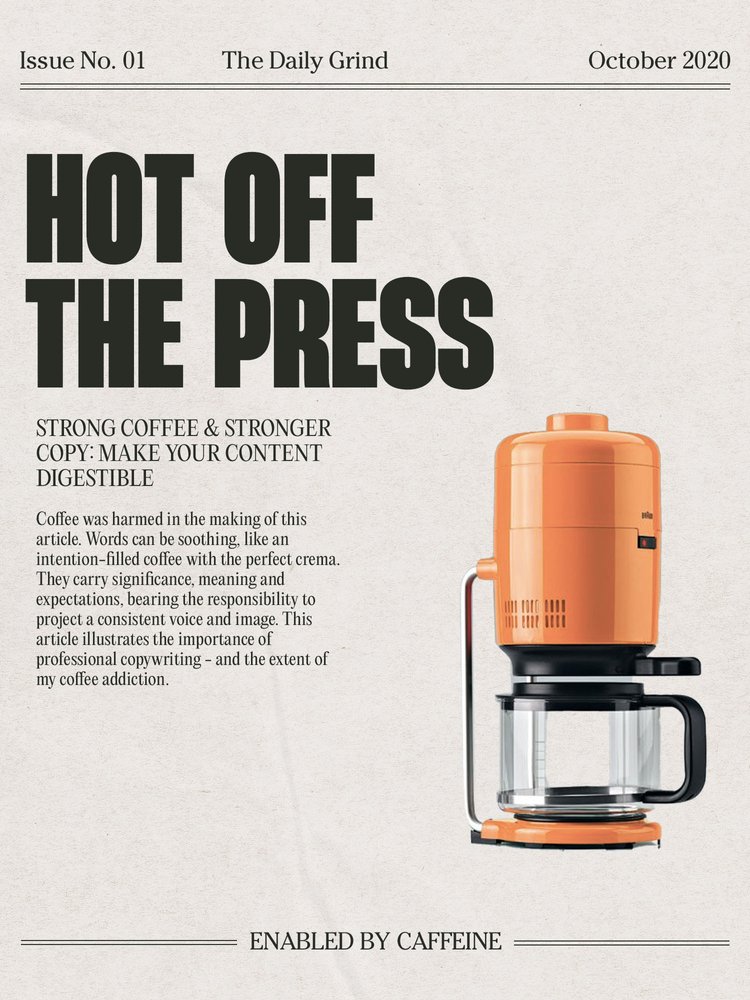
DISCLOSURE: Coffee was harmed in the making of this article.
Like coffee, well-written words don't bore you to death. They keep your readers up late at night, wanting more. Crafted by artisans with a creative flair, strong text is packed with punch and flavour, inspiring readers to think, act and create. On the flip side, a bad coffee – that turns a die-hard into a tea-drinker – is comparable to a clunky paragraph written in poor taste. It's just not digestible.
As readers, we've all been sobered by a spelling mistake, a grammatical error, or an author's subjective bias rearing its unsavoury head in a text. In this decisive instant, the author's credibility – and that of the brand they represent – is undermined, leaving a sour aftertaste and doubt in their readers' minds. Though forgiveable, these mishaps are rarely forgotten. And the rest of the piece? The moment's gone. Would you trust a company with your business if its internal marketing division publishes material unfit for public viewing? Hopefully not. For this reason, the collective copywriting ability of your team needs to be as strong as your morning coffee.
You have 15 seconds before your reader loses interest.
Grabbing attention is hard. Especially when your material is competing in the ocean of information that is the digital world. Once you have a reader, you don't want to lose them to an oversight. Nothing destroys the illusion of sophistication quite like the misuse of a word. Picture yourself, latte in hand, embarking on another regular morning in lockdown. Dreary-eyed, you look to the coffee in your hand as a beacon of strength and energy in the hope of resurrection. Your first sip, fuelled with anticipation, is met with the bleak realisation that your coffee is, in fact, decaf. Sacrilege. A simple mistake really can make or break customer loyalty.
The nerve centre of most cafes, coffee machines – and those operating them – play an integral function. Amid the aroma-filled air of fresh ground coffee beans, these frontline workers are responsible for brewing the perfect pick-me-up. Their craftsmanship is often the difference between a good morning and a mouthful of sad. So too, copywriters play a critical role in the marketing agency. Their work determines the successful delivery of campaigns, the communication of brand identity and the tone of voice that distinguishes one client from the next. An error from their department can compromise the work of their co-creators and, by extension, jeopardise long-standing relationships and client trust. Sloppiness exacts a heavy price.
Committed to the greater good of their community, baristas follow painfully detailed and laborious coffee orders despite their better judgement. No matter how particular or demanding the customer may be, these humanitarians sacrifice their opinions and put on a brave face. Similarly, copywriters, full of opinions and idiosyncrasies, reserve their subjectivity when working on client briefs. Consciously choosing their words, they act on behalf of a client to convey a message that reflects the brand's persona and not their own. With great power comes great responsibility.
Words can be soothing, like an intention-filled coffee with the perfect crema. They carry significance, meaning and expectations, bearing the responsibility to project a consistent voice and image. Copywriting can also act as a nail in the coffin of an otherwise effective marketing campaign when ill-used. If there's anything to take away from this piece, let it be that excellent, professional writing is essential to the delivery and execution of advertising endeavours. The voice your audience hears in their head is a direct result of the words you use to articulate your brand's identity.